
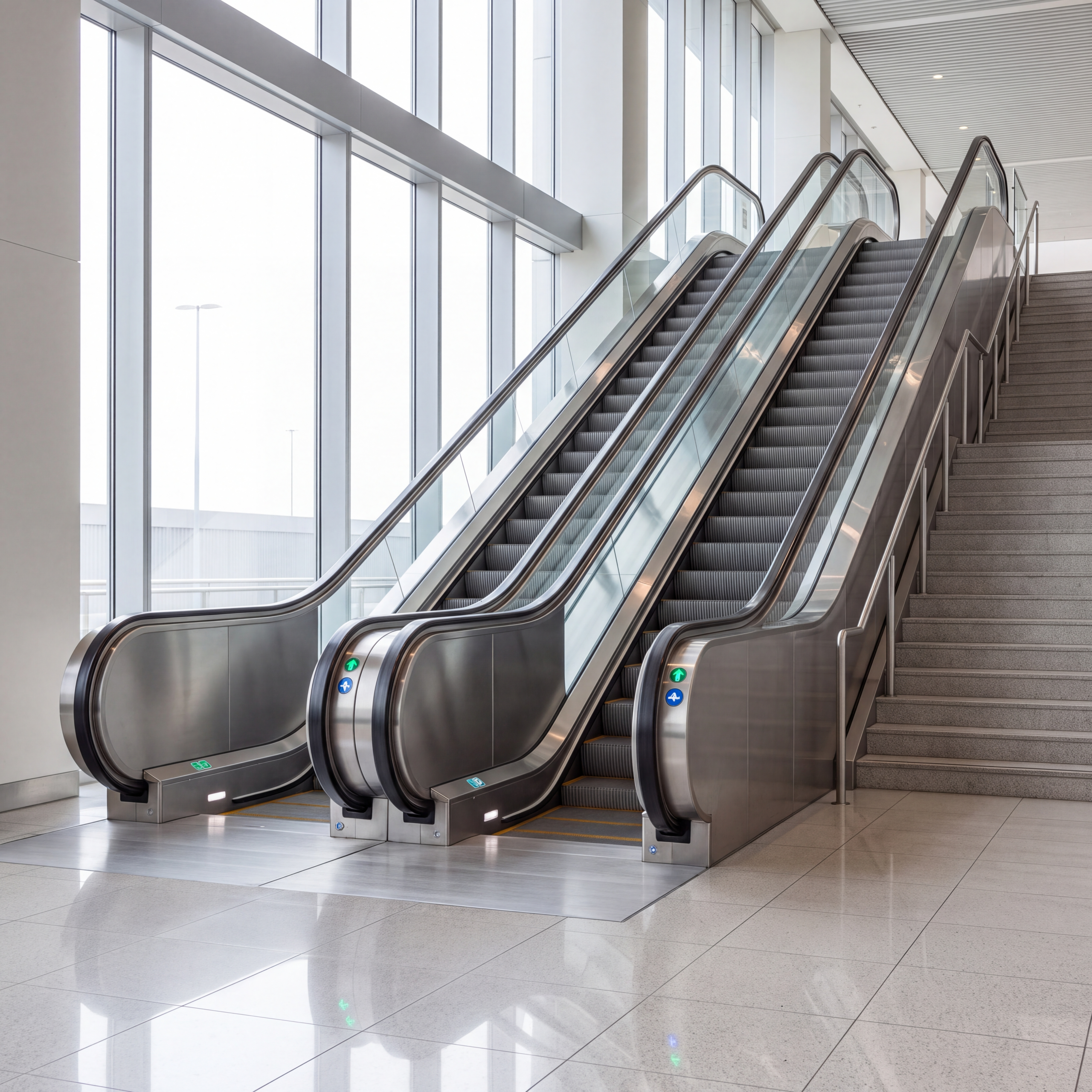
Elevators, Escalators and Walkways
Continuous operation and wear break down standard parts. Custom-engineered urethane parts run quieter, longer.
— The Recurring Problems
Roller guide wheels define the ride
Neoprene or rubber wheels can experience compression set and get noisy with time
Rail liners
Rubber liners can take a set and tear, and bare metal-on-metal can be loud
Step chain rollers
Around-the-clock load makes worn rollers noisy and difficult to roll
Handrail rollers
Must grip and drive the handrail smoothly and quietly, in sync with the steps
Guide rollers
Material wear can let steps, chains and handrails misalign, resulting in added noise and unwanted downtime
Bond & dampening over life
Components must maintain their bond to their core and hold their dampening properties
— The Differentiator
Where standard parts fall short
Because each system is specified to its building, engineers can’t just drop in a catalog part — and the usual materials each fall short somewhere:
- Rubber and neoprene can take a set with time and continuous operation — wheels can go out of round and liners lose thickness, transmitting vibration and noise passengers feel and hear
- Nylon rollers are hard and offer no dampening — they transmit vibration and run loud
- Rubber liners tear, and bare metal-on-metal contact can be loud, harsh and accelerates rail and hardware wear; metal casters and gears wear too
- Incumbent rollers lose roundness and grip — raising rolling resistance, noise and maintenance requirements — and their dampening properties can't be customized
- A standard urethane part comes in stock materials and durometers only — anything needing customized abrasion resistance, dampening or a dual-durometer constructions can't be bought off the shelf
The Result – Compromised ride quality — the very thing passengers judge the system by — plus service callbacks, component replacement, noise complaints in occupied buildings, and higher maintenance needs that recur on high-usage systems.
— Solution Spotlights
The custom parts that solve it
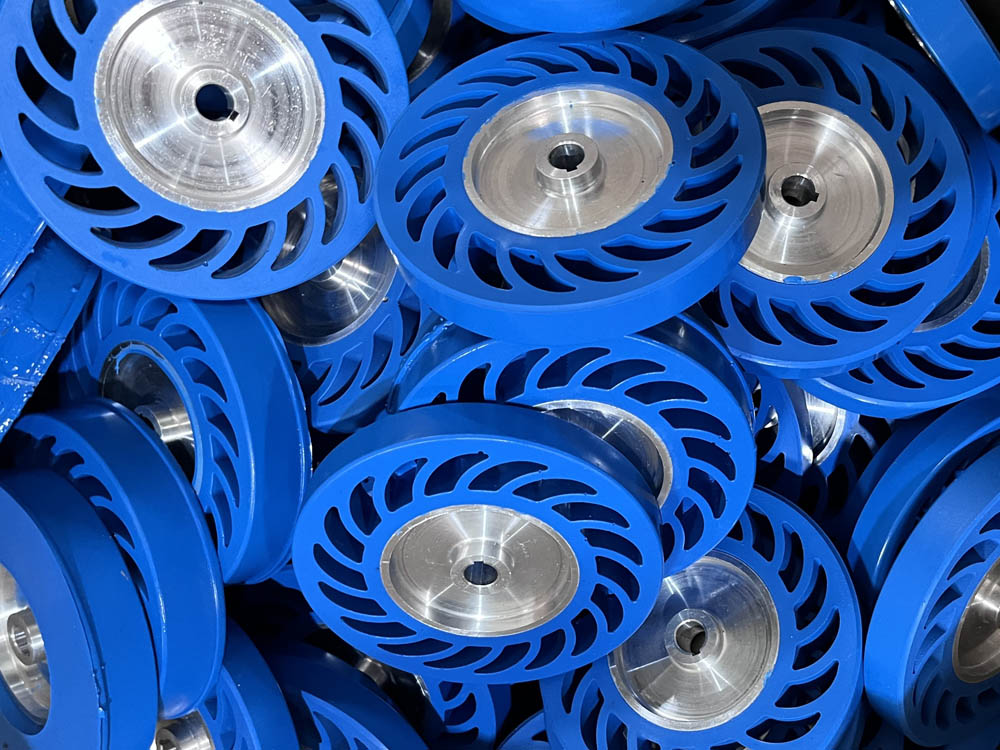
Roller Guide Wheels
Elevator roller guide wheels run against the rails and define ride quality — passengers feel any vibration they transmit. MPC manufactures custom guide wheels using Durethane® S thermoset polyurethanes on bonded cores designed for dampening, so they run quieter and with lower rolling resistance than neoprene or rubber-bonded steel, and don’t go out of round as they age.
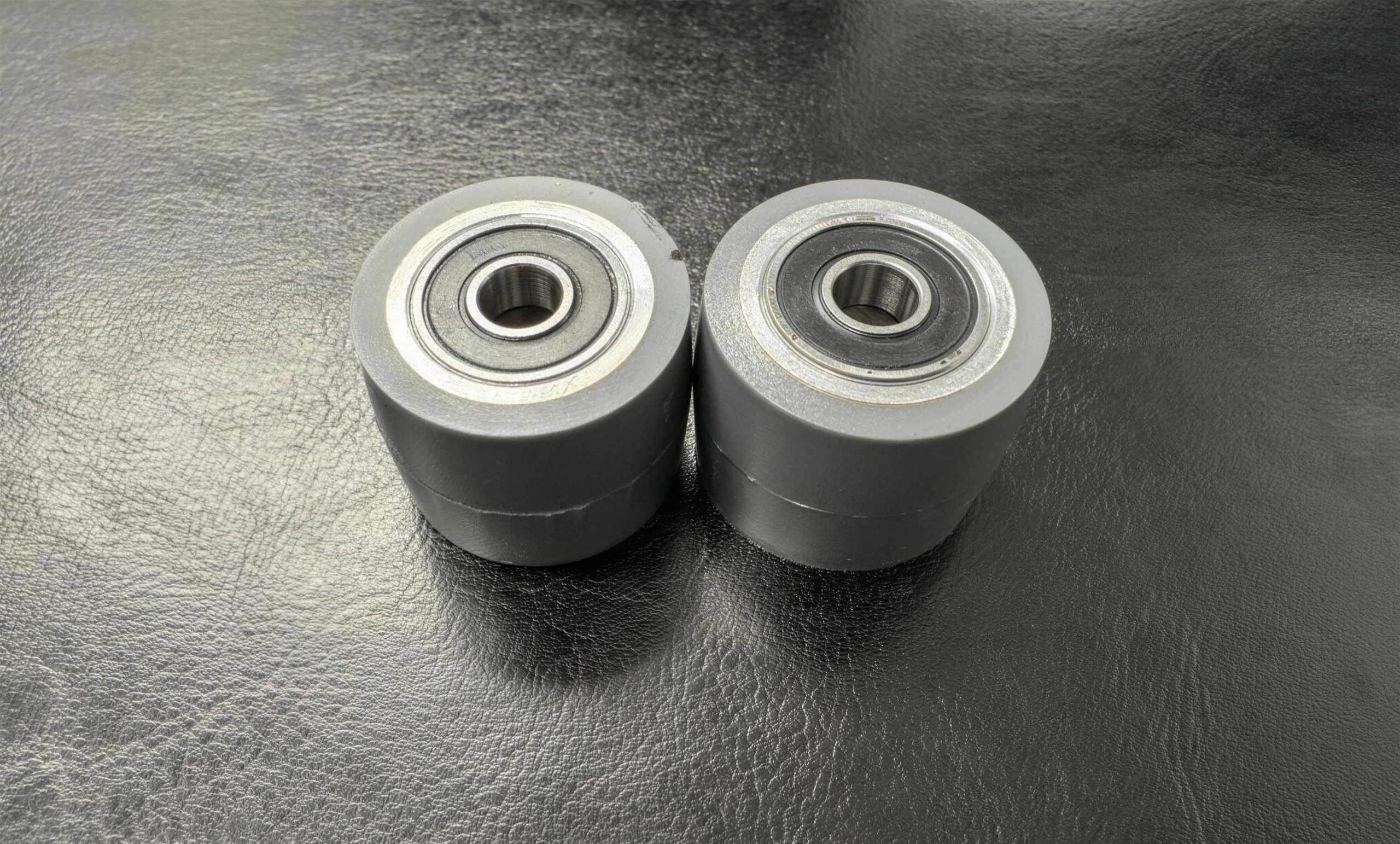
Step Chain & Handrail Rollers
Step chain and handrail rollers carry passenger weight around the clock. MPC manufactures custom-durometer polyurethane rollers on bonded cores, so they run quietly, prevent vibration, and hold grip where rubber components may take a set and nylon generates unwanted noise.

Talk it through with a polyurethane expert who’ll tell you what’s achievable and what is not.
— Technical Specifications
The specs that matter for continuous elevator and escalator duty
Property
Range for this application
Hardness
ASTM D2240
- Shore 20A–70D
- Shore 80A–70D is the typical range for load-bearing roller guide wheels, step guide, and handrail rollers
- Dual-durometer construction available
Durethane® S solid polyureathane mechanical properties
- Tensile strength 250–7,800 PSI
- Tear strength, Die C 30–800 PLI
- Elongation 160–850%
Compression set
ASTM D395
- 5–10% in the Shore 20A–60A hardness range
- 30–40% in the Shore 65A–70D hardness range
- 17–20% in heat- and hydrolysis-resistant polycarbonate-based formulations at Shore 70A–90A
Dampening and vibration
Customized to your exact specifications
Abrasion and surface finish
High abrasion resistance with tolerance to tight surface finishes
Relevant technical downloads
Document
What it gives the engineer
Hardness range 20A–70D with tensile, elongation, tear and compression set per material.
Some of our lowest compression set materials— relevant where a wheel or liner must hold its profile under sustained passenger load
— HOW IT WORKS
From concept to scaled production
Connect With Us
Share your application, performance needs, or a part you want to improve.
Collaborate on Design
Our engineers will help optimize materials and geometry for manufacturability.
Prototype & Refine
We produce samples using our proprietary polyurethane formulations for testing.
Move to Production
Once approved, we move to scalable molding with full quality assurance.
That’s exactly the conversation we like to have – get a polyurethane expert on a quick call to pressure-test your idea before you commit.
— Proof
Case studies & white papers
White Papers
Engineering Polyurethane Components for Heavy-Duty Applications
Modern automation pushes mechanical parts past what standard materials can handle. This white paper covers the material, process, and design choices behind heavy-duty polyurethane components for robotics and precision systems, so they hold up under continuous duty.
Engineering Urethane Wheels and Rollers for Robotics and Automation
Wheels and rollers are among the hardest-working parts in any automated system. This white paper walks engineers through designing them for load, wear, traction, and reliability in heavy-duty robotics, so they last instead of becoming the weak link
Designing Robotic Systems for Shock, Vibration, and Impact
As robots move faster, shock and vibration – not just static strength – drive many failures. This white paper shows engineers how to improve reliability by managing impact energy across the whole system rather than simply building parts stronger.
— Design Guide
How to specify custom urethane rolling and contact parts for smooth and quiet movement of people
Articles & comparisons
— FAQ
Frequently Asked Questions
What roller guide wheel material gives a smooth, quiet elevator ride without the compression-set and noise of neoprene or rubber?
Cast Durethane® S polyurethanes. MPC customizes key material properties, such as dampening, so the system runs quieter and with lower rolling resistance than neoprene or rubber materials, creating components that hold their dimensional integrity instead of taking a set and growing noisy.
For escalator and moving-walkway step, guide and handrail rollers, what runs quieter and lasts longer than rubber or nylon under 24/7 operation?
Custom formulated cast polyurethane. These materials provide components that run quiet and low-vibration and resists wear under around-the-clock passenger load, where rubber may take a set and nylon runs hard and loud — keeping noise, rolling resistance and misalignment down over a long service life.
How do I keep ride-quality rail liners from taking a set and tearing while still dampening vibration?
Use a cast Durethane® S liner, customized for dampening. A dual-durometer construction including a stiff structural backing with a soft contact surface can dampen vibration and stay intact where rubber liners take a set and tear, and bare metal-on-metal runs loud and harsh.
Can a roller be customized for dampening and bonded reliably to a steel core for years of continuous duty?
Yes. MPC casts the urethane onto the steel core so it chemically bonds during cure — a bond stronger than the urethane itself — and can customize durometer for the dampening the ride needs, so both hold through continuous duty.
Can you make a dual-durometer part, a stiff structural backing with a soft contact surface, in one piece?
Yes. MPC manufactures dual-durometer parts that combine a stiff structural backing with a soft contact or dampening surface in a single component, so one part delivers both the support and the quiet, vibration-absorbing contact the application needs.
What lowers rolling resistance and noise on a continuously running car, step band or walkway?
A custom cast urethane part tuned to the system. Lower rolling resistance and quieter operation come from the right material selection, which can minimize costly replacement and unwanted downtime.
— Keep Exploring