
Automotive
Tear, compression set, swell and helium permeation break standard test seals. Custom-engineered polyurethane seals prevail.
— The Recurring Problems
Every part is tested
In-process and end-of-line, at takt, not a sample
Seal drift
Tear or compression set shifts sealing force, and readings drift
False rejects
Good parts pulled into rework and scrap, hurting first-time yield
False accepts
A leak escapes downstream or into the field
Oils, coolant and heat
Machining fluids and upstream heat swell or soften standard seals
Helium permeation
Rubber seals can be permeable, raising tracer-gas background
— The Differentiator
Where standard test seals fall short on the line
Engineers start with catalog rubber or silicone tooling seals — and each falls short somewhere on a testing line:
- Silicone tears under repeated compression at high cycle counts; rubber seals take a set and lose sealing force
- Rubber seals are permeable to helium — raising background and false results on tracer-gas stations
- They swell or soften against machining oils, coolant and cutting fluids, and at upstream-process temperatures
- Catalog shapes can't match a casting, machined boss or battery-tray flange, so the seal seats inconsistently
- A too-stiff or over-forced seal deflects thin battery-tray sheet metal, adding measurement variation
- None can be customized to the combination of durometer, sealing and chemical resistance the testing fixture needs, and stock suppliers offer no engineering support
The Result – When the seal drifts, the whole test is suspect — false rejects into rework and scrap, false accepts heading downstream, stations down for seal changes, and an engineering hunt for a leak that was never in the part.

— Solution Spotlights
The custom parts that solve it
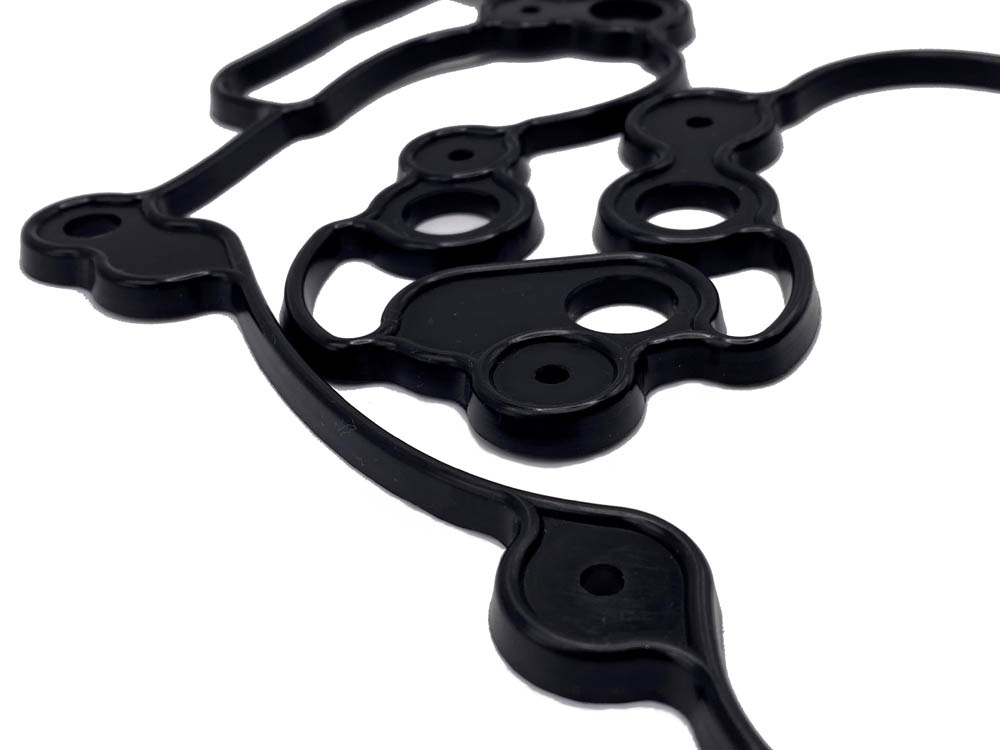
Leak-Test & Seals — Manufactured to Your Specifications
MPC manufactures leak-test and sealing elements to your exact sealing face at your durometer, holding sealing force far longer than rubber or silicone. Polyurethane’s tight molecular structure also blocks the helium that permeates rubber, for cleaner tracer-gas tests, and handles the harshest oils, coolants and residual heat.

Talk it through with a polyurethane expert who’ll tell you what’s achievable and what is not.
— Technical Specifications
The specs that matter for automotive
Property
Range for this application
Hardness (ASTM D2240)
• Shore 20A–70D — solid polyurethane
• Customized per part
Tensile strength (ASTM D412)
• 250–7,800 PSI — solid polyurethane
Elongation (ASTM D412)
• 160–850% — solid polyurethane
Tear strength, Die C (ASTM D624)
• 30–800 PLI — solid polyurethane
Compression set (ASTM D395B)
• 5–40% — solid polyurethane
Chemical exposure
• Thermoset polyurethane resists a wide range of chemicals and oils
• Resistance depends on the specific polyurethane chemistry, operating temperature, aeration and length of exposure
• MPC customizes the material to the fluids and temperatures the station actually sees
Abrasion and surface finish
• High abrasion resistance with tolerance to tight surface finishes
Customizable properties
• Hardness, elongation, tensile, tear and compression set are formulated to the part
• Any shape component, or machined to precise specifications
• Cast onto bonded metal cores and hubs; dual-durometer construction available
Relevant technical downloads
Document
What it gives the engineer
Full solid-grade table: hardness 20A–70D with tensile, elongation, tear and compression set per grade.
The heat-, aging- and hydrolysis-resistant grades, and the lowest compression set in the family.
General chemical resistance guideline by substance, with the conditions the guideline assumes.
— HOW TO WORK WITH US
From concept to scaled production
Connect With Us
Share your application, performance needs, or a part you want to improve.
Collaborate on Design
Our engineers will help optimize materials and geometry for manufacturability.
Prototype & Refine
We produce samples using our proprietary polyurethane formulations for testing.
Move to Production
Once approved, we move to scalable molding with full quality assurance.
That’s exactly the conversation we like to have – get a polyurethane expert on a quick call to pressure-test your idea before you commit.
— PROOF
Case studies & white papers
Case Studies
Robotics OEM Overcomes Material Performance Limitations
A robotics OEM needed a molded part that balanced controlled stiffness, predictable wear, and environmental resistance, something no off-the-shelf material could hit. This case study shows how MPC tuned durometer, additives, and chemistry to deliver it and cut the costly redesign cycles along the way.
White Papers
Engineering Polyurethane Components for Heavy-Duty Applications
Modern automation pushes mechanical parts past what standard materials can handle. This white paper covers the material, process, and design choices behind heavy-duty polyurethane components for robotics and precision systems, so they hold up under continuous operation.
— Design Guide
How to specify custom polyurethane tooling seals for leak testing
What to consider, what’s possible, and where custom urethane outperforms other material options – drawn from the same expertise MPC brings to your application.
— FAQ
Frequently Asked Questions
What sealing-tooling material holds a repeatable seal at takt without tearing or taking a compression set across seal life?
Cast polyurethane. It has far higher tear strength than rubber or silicone — tears and cuts are what take those seals out of service — and low compression set, so sealing force holds cycle after cycle.
How do I cut false rejects and protect first-time yield from test-seal drift on my leak stations?
Start with a seal that doesn’t drift. A cast polyurethane seal holds its shape and sealing force, so when you get a positive you can trust it’s a real leak in the part, not the seal — less downtime, fewer engineering investigations.
What tooling seal is best for helium / tracer-gas testing at tight EV-battery reject leak-rate limits?
Polyurethane, not rubber. Helium is one of the smallest molecules there is, and rubber’s molecular structure lets it permeate through, raising background and false results. Polyurethane’s tighter structure blocks it, so the reading reflects the part.
Can you manufacture custom seals to fit a casting, machined boss or battery-tray flange geometry?
Yes. MPC manufactures the seal to the exact sealing face — casting, machined boss, flange or port — so it seats and seals the same way every cycle, where a catalog seal may not work.
What seals an EV battery tray or cover without over-forcing and deflecting the thin sheet metal during leak testing?
A polyurethane seal customized to the right durometer. MPC manufactures softer grades that conform to a large, thin tray and seal it without deflecting the part.
What stands up to machining oils, coolant and upstream-process heat on leak test stations?
Cast polyurethane resists the machining oils, coolant and cutting fluids that swell or soften rubber, and holds up to upstream-process heat.
— Keep Exploring