
Healthcare Mobility
Sustained loads, aggressive washdowns and cleanroom requirements break standard components. Custom-engineered polyurethanes don’t.
— The Recurring Problems
Flat-spotting under load
Injection-molded plastic wheels flat-spot when parked, and may suffer debonding from the hub
Particle shed & marking
Rubber sheds particles and marks surfaces, failing cleanroom limits
Washdown degradation
Plastics and rubber break down under washdown solutions
Push-pull & noise
Worn or flat-spotted casters raise push-pull force and add noise
Static
Charge builds-up on cleanroom and sensitive electronic equipment
Regulatory compliance
Particle generation, surface marking, or performance failures can compromise regulatory compliance
— The Differentiator
Where standard casters fall short in medical mobility
No catalog caster clears the full set of medical-mobility demands at once, so the usual choices each fall short somewhere:
- Rubber and plastics shed particles, mark floors and limit carry loads — failing cleanroom and lab cleanliness
- Injection-molded plastics tend to flat-spot under sustained static loads, and the tread can debonds from the core
- Plastics and rubber degrade under washdown chemistries and wet service environments
- Worn casters raise push-pull force and add noise
- None can be customized to the combination of load, durometer and cleanliness the environment needs, and stock suppliers offer no engineering support
The Result – Contamination risk in cleanroom and lab, fleet caster replacement, unwanted noise in medical settings, and qualification problems.

— Solution Spotlights
What it is + how it's different
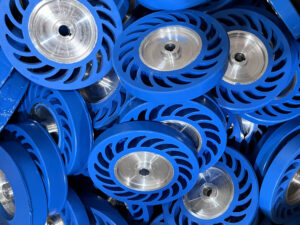
Cast Casters & Wheels — Bonded Core, Cleanroom & ESD Options
MPC manufactures the tread directly onto the metal core so it chemically bonds during the curing process — eliminating the debond that fails injection-molded plastics — and it resists flat-spotting with non-marking materials. Cleanroom and chemically resistant options are available, and conductive polyurethane (Durethane® C) adds ESD control without shedding particles.
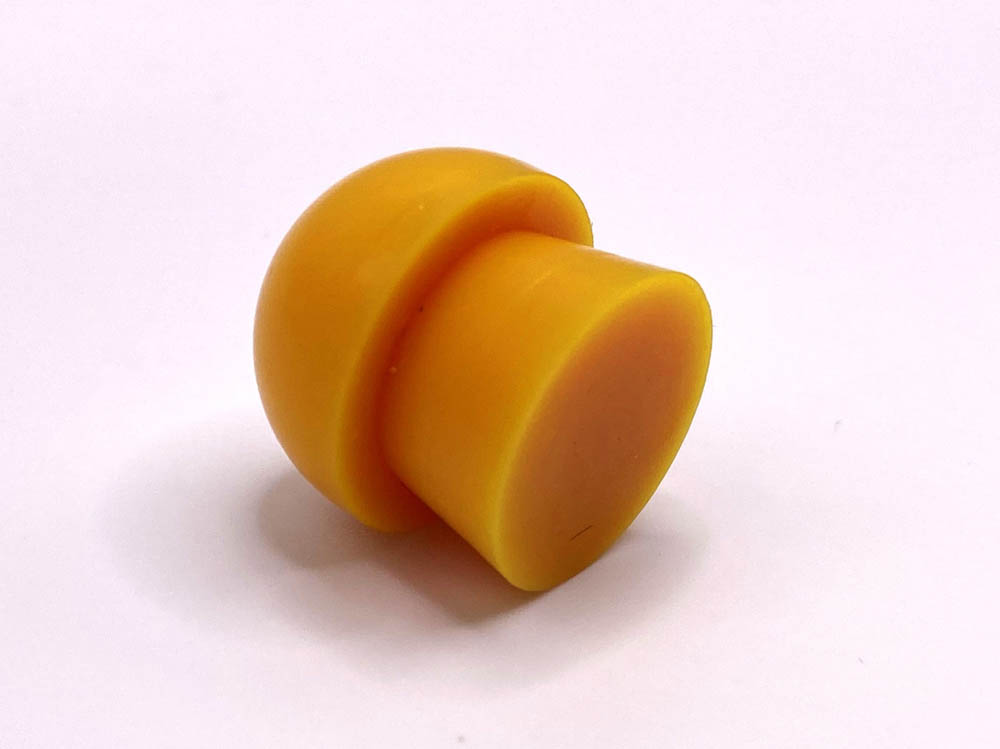
Bumpers
Mobile medical equipment takes repeated impact at doorways, walls and docking points. MPC manufactures custom bumpers customized to the durometer and geometry each system needs, absorbing impact without marking, where a stock bumper can’t meet the complex requirements of your system.

Talk it through with a polyurethane expert who’ll tell you what’s achievable and what is not.
— Technical Specifications
The specs that matter for healthcare mobility duty
Property
Range for this application
Hardness
ASTM D2240
- Shore 20A–70D — solid polyurethane
- Shore 25A–50A — foam polyurethane
- Customized per part
Tensile strength
ASTM D412
- 250–7,800 PSI — solid polyurethane
- 800–1,400 PSI — foam polyurethane
Elongation
ASTM D412
- 160–850% — solid polyurethane
- 330–700% — foam polyurethane
Tear strength, Die C
ASTM D624
- 30–800 PLI — solid polyurethane
- 100–160 PLI — foam polyurethane
Compression set
ASTM D395B
- 5–40% — solid polyurethane
- 17–20% — polycarbonate polyurethane at Shore 70A–90A
Heat, humidity and hydrolysis resistance — polycarbonate polyurethane (Durethane® XL)
- Shore 70A–90A
- Tensile strength 3,000–5,000 PSI
- Tear strength, Die C 225–375 PLI
- Compression set 17–20%
Volume resistivity (Durethane® C)
- Conductive range ≈ 10⁵–10¹¹ Ω-cm
- Typical at ambient, by durometer: 5×10⁵ (10A–55A) · 5×10⁶ (65A–75A) · 5×10⁷ (85A) · 5×10⁸ (90A–60D) · 5×10⁹ (70D)
- Customizable between these values
Conductive polyurethane
- Conductivity is uniform through the whole part, not a surface treatment
- The conductive element does not migrate or leach as the material wears
- Leaves no marks or residues on contact surfaces and does not contaminate devices with shed particles
Mechanical properties — conductive polyurethane (Durethane® C)
- Hardness Shore 20A–70D
- Tensile strength 250–7,000 PSI
- Tear strength, Die C 50–400 PLI
- Elongation 160–850%
- Compression set 5–40%
Chemical exposure
- Thermoset polyurethane resists a wide range of chemicals and oils
- Resistance depends on the specific polyurethane chemistry, operating temperature, aeration and length of exposure
- MPC formulates to the cleaning or disinfection cycle the parts actually run
Customizable properties
- Hardness, elongation, tensile, tear and compression set are formulated to the part
- Any shape component, or machined to precise specifications
- Dual-durometer and cast-to-core construction available
Relevant technical downloads
Document
What it gives the engineer
Solid polyurethane material specifications: hardness 20A–70D with tensile, elongation, tear and compression set.
Conductive polyurethane material specifications, including volume resistivity ranges and material properties.
In-depth overview of MPC’s patented metal-salt conductive technology, which provides stable volume resistivity as parts wear.
Polycarbonate polyurethane material specifications — formulated for humidity and hydrolysis resistance under repeated washdown.
General chemical resistance guideline for MPC’s thermoset polyurethanes.
— HOW IT WORKS
From concept to scaled production
Connect With Us
Share your application, performance needs, or a part you want to improve.
Collaborate on Design
Our engineers will help optimize materials and geometry for manufacturability.
Prototype & Refine
We produce samples using our proprietary polyurethane formulations for testing.
Move to Production
Once approved, we move to scalable molding with full quality assurance.
That’s exactly the conversation we like to have – get a polyurethane expert on a quick call to pressure-test your idea before you commit.
— PROOF
Case studies & white papers
White Papers
Choosing Thermoset Polyurethane for Medical Device Design
Medical device designers weigh polyurethane against metal and plastic without much to compare them on. This white paper sets thermoset polyurethane beside both — on flexibility, customizability, molding options and biocompatibility — and walks through a mobile imaging case where a custom cast bumper stopped a retracting cord from damaging the machine.
Engineering Polyurethane Components for Heavy-Duty Applications
Modern automation pushes mechanical parts past what standard materials can handle. This white paper covers the material, process, and design choices behind heavy-duty polyurethane components for robotics and precision systems, so they hold up under continuous operation.
Engineering Urethane Wheels and Rollers for Robotics and Automation
Wheels and rollers are among the hardest-working parts in any automated system. This white paper walks engineers through designing them for load, wear, traction, and reliability in heavy-duty robotics, so they last instead of becoming the weak link.
— Design Guide
How to specify custom polyurethane casters and wheels for medical mobility
— FAQ
Frequently Asked Questions
What caster material is non-particulating and non-marking and survives chemical washdown for cleanroom and lab equipment?
A cast polyurethane wheel. MPC manufactures non-particulating, non-marking wheels and can use hydrolytically stable chemistries that hold up to CIP / SIP washdowns, where rubber sheds and plastic degrades.
What stops flat-spotting and tread peel on hospital bed and cart casters under sustained load?
A cast polyurethane tread bonded to a metal core. Polyurethane provides a low compression set — the root-cause for flat-spotting — and the material chemically bonds to the core, so it can’t peel or debond like injection-molded plastics.
How do I lower push-pull force with longer-life wheels?
Keep the wheels from flat-spotting. A flat-spotted or worn caster is what raises push-pull force, so a cast polyurethane wheel that resists flat-spotting and holds its shape keeps rolling force and noise down over life. MPC customizes your wheels or casters for the exact needs of your system.
Can casters be made static-dissipative for cleanroom or sensitive equipment?
Yes. Durethane® C is a metal-salt conductive polyurethane that dissipates static without shedding particles, with volume resistivity customized to your ESD target across roughly 10⁵–10¹⁵ Ωcm — so static is managed instead of damaging the equipment.
Can you bond the wheel to a metal core so the tread won't debond?
Yes. MPC manufactures the tread directly onto the metal core so it chemically bonds during cure — a bond stronger than the polyurethane itself. That eliminates the tread peel and debond failure mode of injection-molded plastics under load.
— Keep Exploring