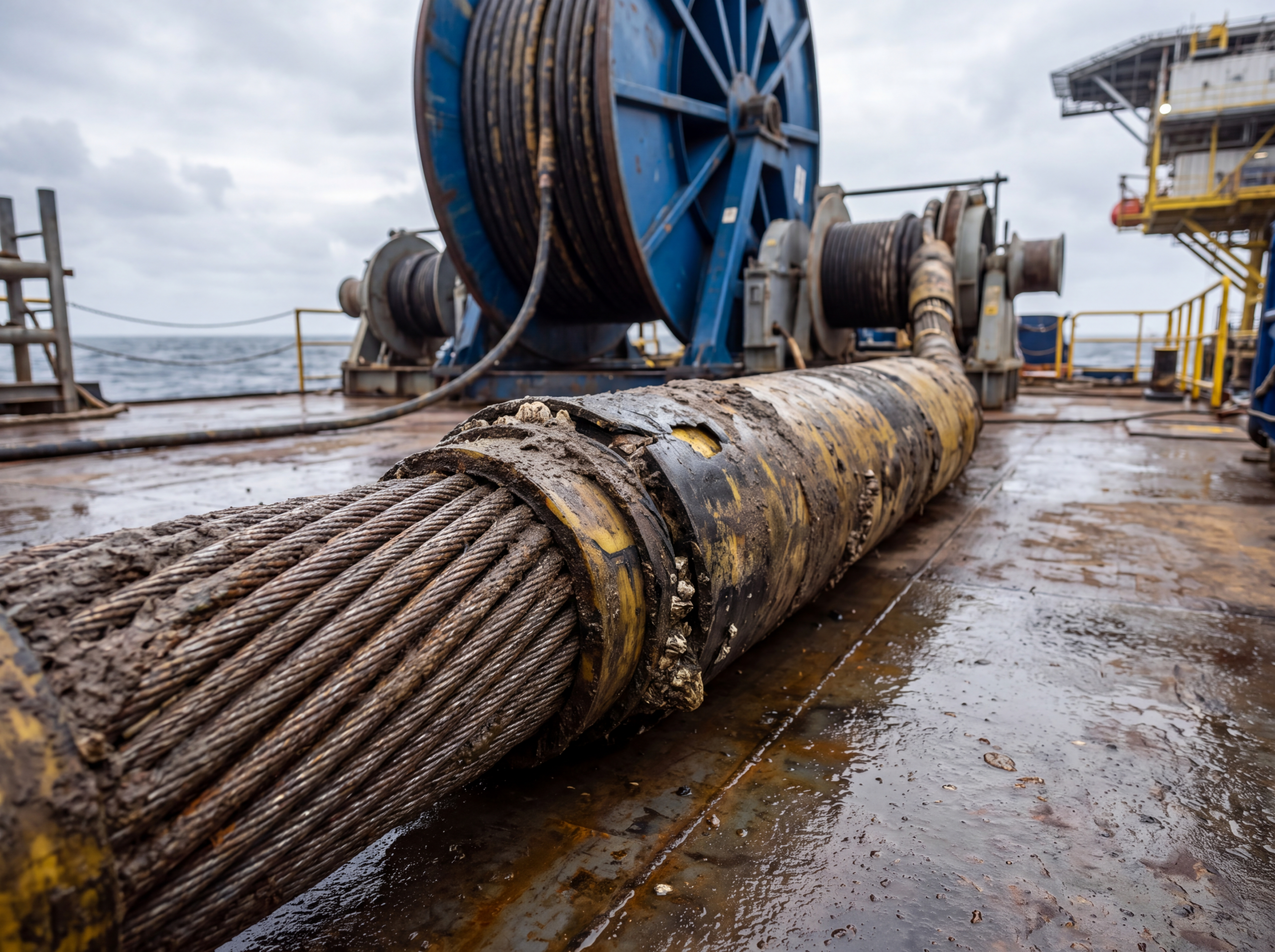
Cables, risers and umbilicals need bend protection for years
Subsea degradation
Plastics hydrolyze, age and abrade under prolonged exposure
Corrosion and weight
Metal corrodes, adds weight and needs cathodic protection or coating
Hardware on deck
Bolted VBRs need marine-grade hardware on every segment, slow and costly to install
Vessel time
Spread time is the most expensive clock offshore
Enclosure integrity
System enclosures must hold-up against saltwater, humidity, harsh chemicals, and temperature swings
Large geometries
Subsea parts get big, beyond what catalog shops can produce
— The Differentiator
Where standard subsea parts fall short
Engineers reach for plastic VBRs, metal bend stiffeners, covers and enclosures, or bolted multi-part VBR designs — and each falls short offshore:
Subsea degradation — plastics hydrolyze, age and abrade under prolonged exposure and fail at depth
Metal corrodes, is heavy, needs cathodic protection or coating, and is costly to machine
Bolted VBRs need costly marine-grade bolts, washers and nuts on every segment
That hardware burns deck and vessel time and adds risk from managing many small parts
Catalog shops can't produce the large, complex geometries subsea parts need
None can be customized to the geometry, bend profile and marine exposure a subsea line needs, and stock suppliers offer no engineering support
The Result – Risk to the umbilical or cable itself — catastrophic and expensive to recover — plus corrosion and maintenance on metal parts, and costly vessel time spent installing hardware instead of running the job.
— Solution Spotlights
The custom parts that solve it
Vertebrae Bend Restrictors (VBRs) — Boltless & Bolted
VBRs protect subsea cables, risers and umbilicals from damage caused by excessive bending. MPC’s patented boltless VBRs install about 40% faster than traditional bolted VBRs, with far fewer pieces. MPC’s bolted VBRs and bend stiffeners are designed to meet the most demanding off-shore specifications.
ROVs and subsea equipment work at depth in salt water through wide temperature swings and water pressures. MPC manufactures ROV bucket covers, clamps, thread protectors and marine pads and bumpers to your geometry, resistant to saltwater and temperature extremes where machined metal corrodes and dents.
Published bolted and boltless VBR specification tables: segment sizes, weights in air and seawater, flange and lock-out radius options, and bend moments per size.
Bolted vertebrae bend restrictors need marine-grade hardware on every segment, burning expensive deck and vessel time. This case study shows how MPC’s patented boltless clip design installed about 40% faster with far fewer pieces to manage, without giving up bend protection.
Engineering Polyurethane Components for Heavy-Duty Applications
Modern automation pushes mechanical parts past what standard materials can handle. This white paper covers the material, process, and design choices behind heavy-duty polyurethane components for robotics and precision systems, so they hold up under continuous operation.
What material outlasts plastic bend restrictors for subsea cable and umbilical protection?
Cast polyurethane. Seawater does not attack it, so it does not corrode like metal or age and abrade the way plastics do at depth, and it flexes through cyclic bending without going brittle. MPC’s VBRs need no special coatings.
How do boltless VBRs cut offshore installation time and cost versus bolted designs?
Fewer pieces. A boltless VBR is two halves and clips, installed with a dead blow hammer and an allen key — no marine-grade bolts, washers or nuts. MPC timed both: the clip design can be installed about 40% faster.
What replaces heavy, corroding metal bend stiffeners and enclosures subsea?
Cast polyurethane. It doesn’t corrode, so it needs no cathodic protection or coating, and it is far lighter.
Can you mold large-format, complex subsea geometries?
Yes. MPC manufactures parts as large as a pickup truck. Send us your design and MPC will guide you through the product development and scale-up process.
What holds up as a marine electronic enclosure against saltwater, humidity and temperature extremes?
A cast polyurethane enclosure. MPC built one for an offshore energy customer to replace machined marine-grade metal — it held stringent dimensional and performance specs, resisted saltwater, humidity and temperature extremes, at far lower costs.