
Industrial
MPC manufactures custom-engineered urethane parts for industrial equipment — wheels, rollers, belts, bumpers and seals formulated for the continuous operation that wear out off-the-shelf components.
— Recurring Problems in Industrial Environments
Continuous operation
Parts that flat-spot, glaze or wear out drive unplanned downtime
Load and impact
Concentrated loads and repeated impact break standard components
Static buildup
Insulating materials build charge around sensitive electronics and product
Contamination
Particle shed, marking and residue fail cleanliness requirements
Chemical and thermal exposure
Process chemistry, wash-up and heat degrade common elastomers
Precision surfaces
Grip, finish and profile have to hold consistently, part to part and cycle to cycle
— The Differentiator
Where catalog materials fall short in industrial equipment
No off-the-shelf material clears the full set of industrial demands at once, so the usual mix — rubber, plastics, catalogue urethane, metal — each falls short somewhere:
- Rubber can take a set and go out of round under sustained load
- Injected-molded plastics tend to debond from subcomponents and wear fast under concentrated loads
- Catalog urethane comes in fixed durometers, so material properties can’t be customized to meet difficult specifications
- Insulating plastics and elastomers build static charge around sensitive product
- Carbon-loaded conductive materials shed particles and lose conductivity as they wear
- Metal is durable but marks product, transmits noise and adds weight
The Result – Unplanned downtime, damaged product, failed qualifications, and costly maintenance cycles.
— Applications
Where custom urethane is already at work
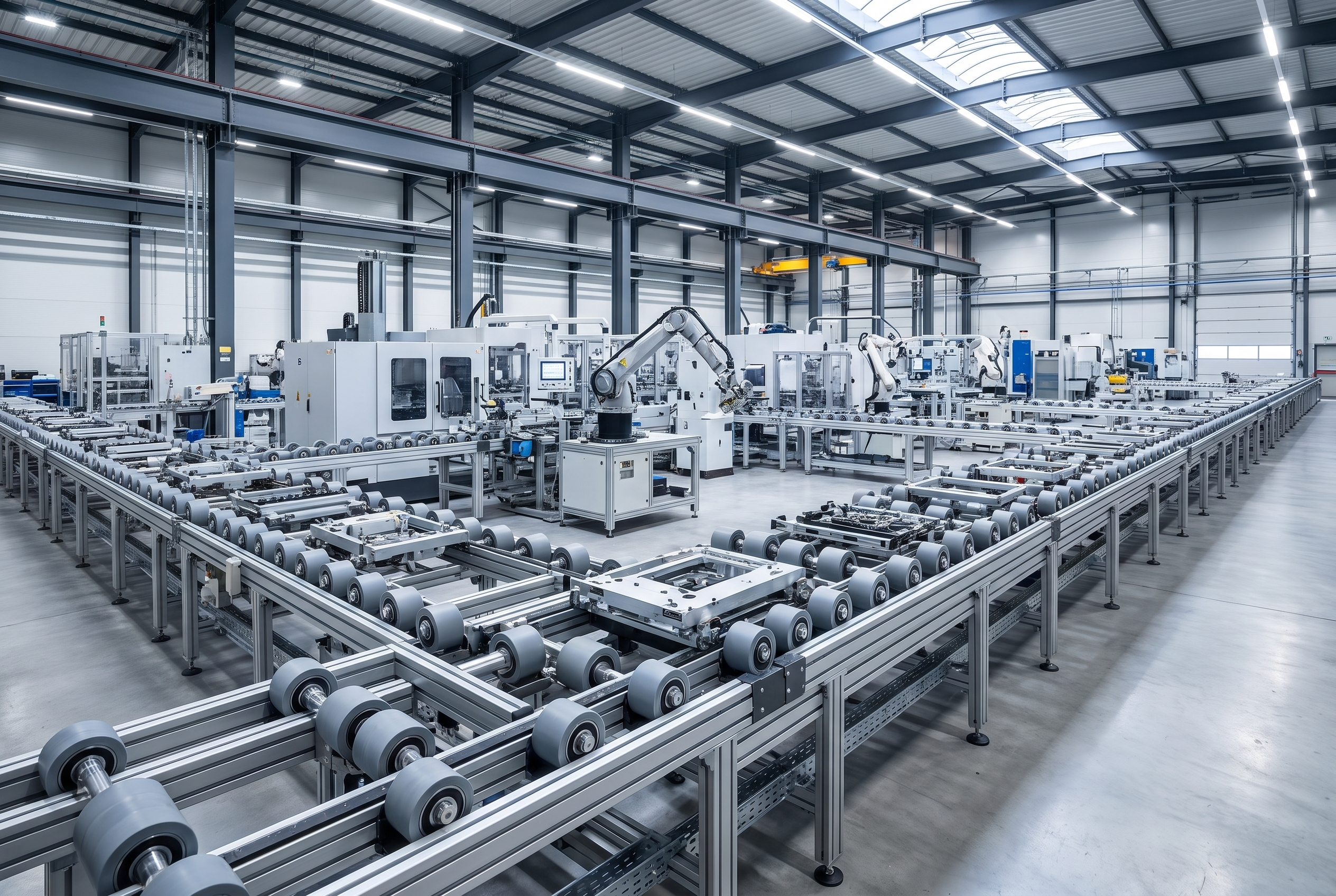
These are the industrial applications MPC works in most often. Because every part is custom formulated for the application rather than selected from a range, the list is a starting point rather than a limit — if a component on your equipment keeps failing, we can explore if MPC’s engineered polyurethanes can be a solution.
Baggage systems run every shift and carry the whole terminal’s throughput, so a worn wheel or a flat-spotted roller becomes a delayed flight. MPC manufactures wheels, rollers and bumpers for continuous conveyor and sortation applications.
Autonomous robots run near-continuously in facilities where a static discharge can damage critical electronics. MPC manufactures conductive wheels, rollers and belts customized to meet stringent material specifications — including cleanroom-compliant parts.
Converting lines run fast, and failed components show up in the finished sheet. MPC manufactures conductive feed, pull and backing rollers that hold a consistent nip across the web.
Roller guide wheels and step rollers carry passenger load every day for decades, and riders notice the moment they start to wear. MPC manufactures custom urethane components for quiet, long-lifecycle motion.
Feed, pinch and nip rollers control the media, and changes in coefficient of friction become a misfeed or a registration error. MPC manufactures rollers with the coefficient of friction customized to the media.
Wire saw guide rollers hold wire alignment through precision slicing, and worn grooves sacrifice costly material. MPC coats, grooves and refurbishes guide rollers domestically to support your process scale-up and keep them running efficiently.
Wire saws slice ingots to tight tolerances, and a worn guide groove may cause downstream failures. MPC coats, grooves and refurbishes wire saw guides and pulleys, and manufactures conductive, low-outgassing components for wafer handling systems in cleanroom environments.

Talk it through with a polyurethane expert who’ll tell you what’s achievable and what is not.
— HOW TO WORK WITH US
From concept to scaled production
Connect With Us
Share your application, performance needs, or a part you want to improve.
Collaborate on Design
Our engineers will help optimize materials and geometry for manufacturability.
Prototype & Refine
We produce samples using our proprietary polyurethane formulations for testing.
Move to Production
Once approved, we move to scalable molding with full quality assurance.
— Case Studies
Proven in production
Customers come to MPC with a component that keeps failing, or a new part that has to be designed from scratch. These are the results — less downtime, lower cost, and products that reached the market on schedule.
Static control
A warehouse automation OEM was losing uptime to static discharge and roller wear in its AMRs. This case study shows how MPC engineered a conductive roller that reduced ESD faults by roughly 70% and delivered 2.5× the roller life.
Contamination control
A semiconductor automation manufacturer needed rollers that were cleanroom-compliant, long-wearing, and static-controlled all at once. This case study shows how MPC’s custom conductive formulation passed ISO cleanroom testing and ran roughly 4× longer than the plastic rollers it replaced, with zero contamination events.
Load and continuous duty
A continuous-duty robotics manufacturer kept losing rollers to flat-spotting under constant load and start-stop motion. This case study shows how MPC’s custom roller eliminated the flat spots and delivered about 2× the service life, cutting the unplanned maintenance that was slowing the line.
— Solutions
Common problems we solve
These are the problems custom urethane technology is most often specified to solve, across every kind of industrial equipment.
Paper, film, board and packaging have to be gripped, moved and released without slipping or marking. Urethane contact surfaces are formulated with the coefficient of friction tuned to the media, and hold it consistently unit to unit.
Wheels, rollers and drive elements carry load and transmit motion every shift. Cast urethane holds its profile and runs quietly where rubber goes out of round and plastic wears through.
Hard stops and rigid components pass shock straight into the machine. Urethane and urethane foam absorb impact through controlled compression, without slowing the system.
Seals and gaskets have to hold under pressure, chemical exposure and repeated cycles. Custom urethane is formulated to the fluid, the pressure and the temperature the seal will actually experience in operation.
Insulating parts build static charges around sensitive electronics. MPC’s patented metal salt conductive urethane technology dissipates it uniformly through the whole part, and keeps doing it as the part wears.
That’s exactly the conversation we like to have – get a polyurethane expert on a quick call to pressure-test your idea before you commit.
— FAQ
Frequently Asked Questions
What industrial applications use custom polyurethane parts?
Custom polyurethane parts run wherever standard components wear out too quickly or can’t satisfy more than one requirement at once. MPC manufactures wheels, rollers, belts, bumpers, seals and drive elements for baggage handling, warehouse automation, corrugate converting, elevators and escalators, industrial printing, precision wire saws and semiconductor equipment.
When is a custom urethane part worth it over a standard one?
Custom formulation is worth it when one part has to satisfy competing requirements — grip and wear life, cleanliness and durability, or load capacity and quiet operation. Standard parts are formulated for typical duty, so meeting complex demands usually means accepting a compromise somewhere.
Can urethane parts be made conductive for static-sensitive equipment?
Yes. MPC’s patented metal salts technology incorporates conductive elements into the polymer before it cures, so conductivity is uniform through the whole part rather than a surface treatment. Volume resistivity is formulated across roughly 10⁵ to 10¹¹ Ω-cm, and it does not shed particles or drift as the part wears.