
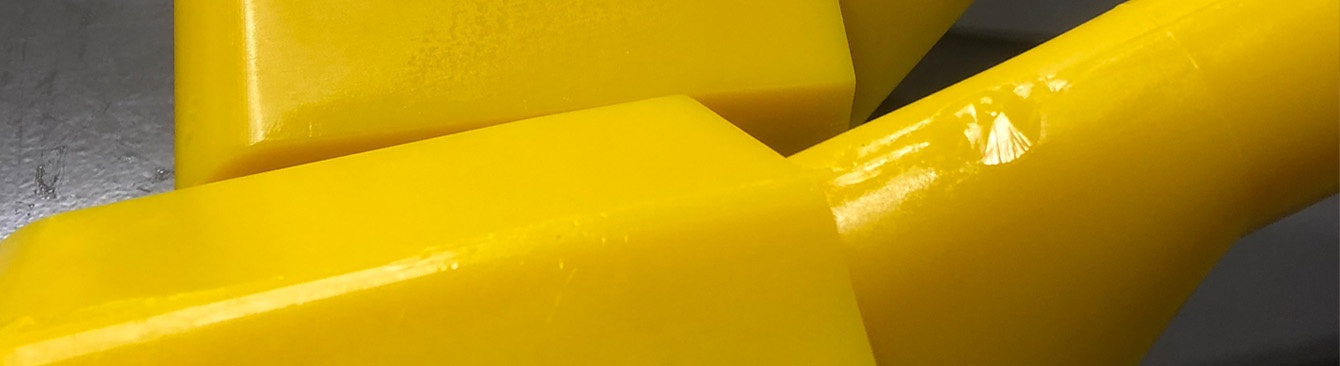
Rubber has earned its place in industrial design. It’s cost-effective, widely available, and backed by decades of application-specific validation. But when rubber components start failing ahead of schedule, cracking under load, swelling from chemical exposure, and wearing out faster than the equipment they protect, engineers need a clear, material-level answer to a direct question: in a polyurethane vs. rubber comparison for industrial components, which one is better for your application?
This guide is built for product designers and engineers who are currently using rubber components and want an honest evaluation of where thermoset cast polyurethane delivers better performance, longer service life, and lower total cost of ownership, and where rubber still holds its ground.
What Is Rubber: A Baseline
What is rubber, in the context of industrial components? It covers both natural rubber latex and a broad family of synthetic compounds including neoprene (CR), EPDM, nitrile (NBR), and others, all of which share elastomeric behavior and a long track record in sealing, vibration damping, and flexible coupling applications.
Rubber properties that make it useful include high flex at low temperatures, strong vibration isolation, predictable bonding to metal through vulcanization, and established compliance pathways for FDA and NSF contact applications. Understanding what rubber does well is helpful when comparing it to thermoset polyurethane.
Head-to-Head: The Properties That Determine Component Life
Abrasion Resistance
Abrasion resistance is where thermoset polyurethane consistently and significantly outperforms rubber. Thermoset polyurethane formulations routinely demonstrate 3 to 5 times greater abrasion resistance than natural rubber in standardized Taber and DIN abrasion testing. For components involving sliding contact, repetitive wear, or abrasive particulate such as conveyor systems, scraper blades, and wear liners, thermoset polyurethanes can extend service life and system reliability..
Load-Bearing Capacity and Compression Set
Rubber deforms under load and recovers. That recovery is useful in dynamic applications, but rubber’s load-bearing capacity is limited by its relatively narrow hardness range and lower modulus. Polyurethanes can be formulated across a Shore A 20 to Shore D 75 hardness range without sacrificing elastic recovery, giving designers access to harder durometer ranges that rubber simply can’t reach without becoming brittle.
Compression set, which is the degree to which a material permanently deforms after sustained compression, is a common failure mode in rubber seals and gaskets. At elevated temperatures, rubber loses physical properties progressively. Durethane® formulations engineered for sealing applications resist that permanent deformation, which translates directly to longer service intervals and more reliable sealing performance over the life of the part.
Chemical Resistance
Both materials offer chemical resistance, but rubber requires a compound-by-compound approach: nitrile for petroleum fluids or EPDM for ozone and weathering. Each compound is optimized for a specific exposure range, which creates complexity when a component faces multiple chemical environments or when design requirements change.
Polyurethanes provide broad resistance to oils, greases, fuels, and common industrial solvents, and MPC’s engineering team can match a specific formulation to the actual chemical environment of a given application. Where rubber demands a different compound for each exposure scenario, a single Durethane® material often covers the full range. For industries like energy, where components see hydrocarbon fluids, drilling muds, and ozone simultaneously, that versatility carries real operational value.
Outdoor and UV Durability
Because rubber is derived from natural latex chemistry, it is inherently biodegradable and degrades over time with exposure to sunlight, ozone, and outdoor environments. Thermoset polyurethane can be formulated to resist UV degradation and weathering at a level that most rubber compounds cannot match. For outdoor-rated bumpers, seals, or rollers, thermoset polyurethane deliver a durability advantage that compounds over extended field service.
Application-Specific Considerations Across MPC’s Product Lines

- Seals and Gaskets: Compression set, chemical resistance, and dimensional consistency drive the material decision here. Polyurethane seals and gaskets formulated in Durethane® grades perform significantly longer in hydraulic, oil-and-gas, and chemical processing environments where rubber seals lose sealing force through thermal compression set.
- Wheels and Rollers: Abrasion resistance, load capacity, and compression set are the deciding factors. Polyurethane wheels and rollers in Durethane® formulations consistently outlast rubber in abrasive conveyor and automation environments, a proven advantage across warehouse robotics and semiconductor automation applications where particulate contamination and wear tolerance are both critical.
- Bumpers: Impact energy return, UV durability, and dimensional stability favor polyurethane. Durethane® bumpers absorb impact while keeping their shape rather than permanently deforming, extending part life in dock, material handling, and automated guided vehicle environments.
- Belts: Cut resistance, flex fatigue resistance, and chemical tolerance are the key properties for drive and conveyor belt applications. Polyurethane belts deliver the combination of tensile strength and surface durability that rubber belts lose as they age and fatigue.
Frequently Asked Questions
Can polyurethane be bonded directly to metal the same way as rubber-to-metal bonded parts?
Yes. MPC produces thermoset cast polyurethane bonded to metal substrates across its product lines. The adhesion mechanism differs from rubber vulcanization, but bond strength is comparable for the large majority of industrial applications. MPC’s engineering team evaluates each bonded part design individually through its engineering support process.
How does polyurethane compare to neoprene or EPDM rubber for outdoor or UV-exposed applications?
Neoprene and EPDM offer better UV and ozone resistance than natural rubber, but thermoset polyurethane can be formulated to outperform both over extended outdoor exposure. Because rubber is biodegradable at its chemistry level, it degrades over time in ways that a polyurethane does not. For outdoor seals, bumpers, and wear components, polyurethane typically outlasts neoprene and EPDM in long-duration field service.
Is cast polyurethane compliant with FDA or NSF standards for food-contact applications the way certain rubbers are?
Polyurethane materials are available in FDA compliant formulations. Compliance is formulation-specific and application-specific, not a blanket claim across all grades. MPC’s engineering team can identify compliant formulations for a given food or potable water contact application during the design process.
The Benefits of Polyurethane, Applied to Your Specific Part
The benefits of polyurethane over rubber are real, but they’re most valuable when matched to the actual demands of a specific component. A Durethane® formulation selected for abrasion resistance in a conveyor roller is a different specification than one selected for compression set in a hydraulic seal. Both differ from a food-grade formulation for a processing line application.
MPC’s engineering team evaluates existing rubber parts and recommends matched Durethane® formulations based on the actual operating conditions: load, temperature, chemical exposure, contact dynamics, and dimensional requirements. If you’re considering a rubber-to-polyurethane conversion or designing a new component that needs to outlast what’s in the field today, request a quote and our team will assess your application directly.