
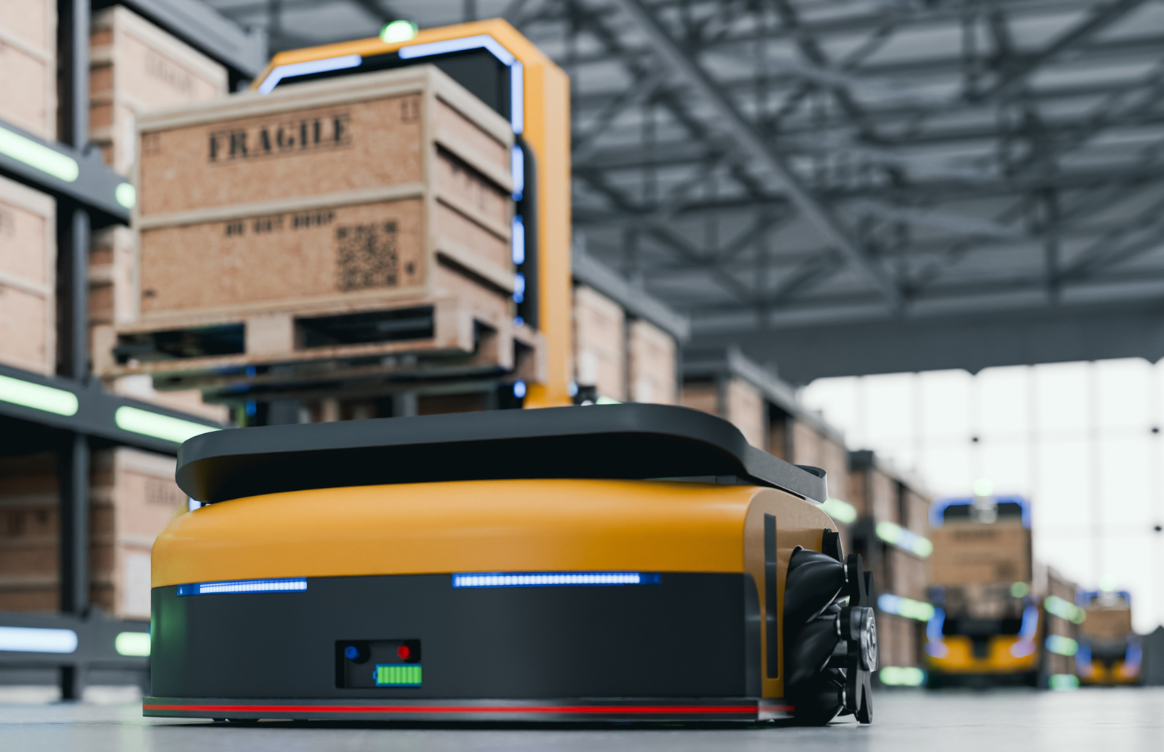
Robots reduce costs and enhance productivity by handling repetitive, high-volume production, managing hazardous environments, and improving accuracy across a wide range of industries, from industrial & warehouse to medical. Though productive, robots face common challenges, such as traction, component failure, and vibration, that impact overall operating efficiency. These challenges are easily solved with the right material, reducing downtime and optimizing productivity.
Poor Traction and Inconsistent Navigation
Autonomous Mobile Robot (AMR) wheels can struggle with slippage, missed paths, and inefficient routing, especially on polished concrete, epoxy, tile, or uneven flooring. Polyurethane wheels solve this with custom-tuned surface finishes and precise Coefficient of Friction (CoF) adjustments that deliver consistent grip across multiple surfaces. The result is smoother, more reliable AMR path tracking, fewer navigation errors, and improved energy efficiency.
Premature Wear and Component Failure
High-traffic automation environments can quickly degrade inferior wheels, rollers, and casters, leading to frequent downtime and costly replacements. Polyurethane’s superior abrasion resistance and customizable durometers extend component lifespan, minimizing maintenance cycles and improving total cost of ownership. Resulting in less downtime and lower maintenance costs.
Inability to Perform in Cleanroom and Sensitive Environments
Robots operating in semiconductor, pharmaceutical, or electronics manufacturing environments must meet strict standards for particulate generation and static discharge. Polyurethane is cleanroom-grade and ESD-safe, ensuring low particle shedding and electrostatic protection, keeping robots compliant without sacrificing performance, and reducing the risk of contamination and product loss.
Vibration, Shock, and Load Management Issues
Poor shock absorption can lead to navigation errors, component damage, and reduced sensor accuracy, especially for robots carrying sensitive payloads. With polyurethane, the durometer can be customized to absorb vibration and impact forces, protecting both the robot and the payload while maintaining smooth navigation across uneven surfaces.
Conclusion
In robotics applications, reducing downtime and optimizing productivity are essential to lowering operating costs. Common challenges like traction, component failure, and vibration are easily solved with the right material—polyurethane.