
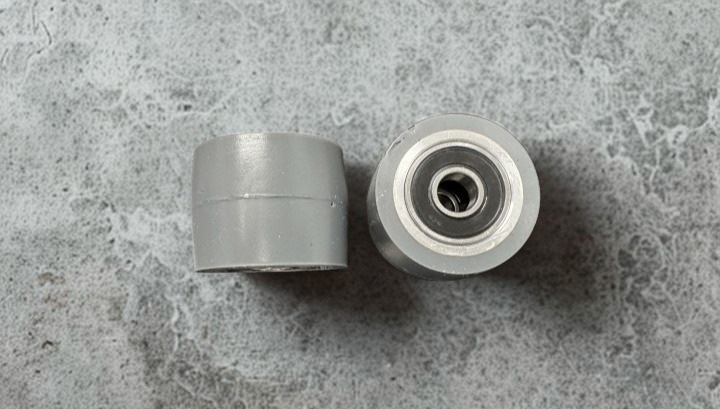
Semiconductor automation systems operate in some of the harshest and most demanding environments in manufacturing. Clean rooms require near-zero particle generation, precise motion control, and materials that can handle chemical exposure without degrading.
For years, automation engineers relied on rubber or plastic rollers because they were readily available and easy to replace. As clean‑room standards tightened and system speeds increased, the limitations of rollers made from traditional materials became more apparent—cracking under heat, shedding particles, absorbing solvents, and losing dimensional accuracy under load.
In semiconductor automation, rollers that move wafers, carriers, or components are critical to maintaining yield and uptime, requiring a material that can meet the demands of this environment.
Polyurethane’s Physical Properties Outperform Other Materials
Choosing the right material is essential, and polyurethane offers superior physical properties compared to rubber or plastic. Its chemistry allows for a broad range of hardness (Shore 10A to 85D), and conductive formulations for static dissipation or charge transfer used in cleanroom systems.
Polyurethane resists swelling and degradation from chemicals commonly used in environments — isopropyl alcohol, cleaning solvents, and etching residues that quickly degrade other materials. It also does not outgas or shed micro‑particles that contaminate wafers or sensors.
The dimensional stability of polyurethane is a significant advantage, as it maintains its shape under load and over time, reducing drift and variation in precision-motion systems.
In semiconductor applications, rollers manufactured with polyurethane’s superior physical properties consistently deliver performance, reducing maintenance and requiring fewer calibration cycles.
Polyurethane Rollers are the Optimal Choice in Semiconductor Automation
In semiconductor automation, material selection directly affects contamination control, motion accuracy, and system uptime. Polyurethane rollers exceed these requirements by maintaining dimensional stability under load, resisting degradation from common cleanroom chemicals, and operating without particle shedding or outgassing. Unlike traditional rubber or plastics that deform, crack, and absorb solvents over time, polyurethane formulations are tailored to precise hardness, conductivity, and mechanical tolerances required for wafer handling and precision transport. This combination of chemical resistance, cleanliness, and long‑term mechanical stability makes polyurethane a reliable, superior material choice for rollers used in high‑precision, cleanroom automation systems.