
Now that you’ve gone through the product development stage and identified a suitable material and manufacturing process to achieve your exact design and performance requirements – You’re probably eager to move into production… But wait! Have you considered what type of surface finish is required? Defining a clear surface finish specification early on with your manufacturer will set quality expectations, improve manufacturing efficiency, and ultimately dictate your part’s overall look and feel.
Below we will summarize the three types of surface finish classifications available so you can make the best design decisions for optimum results.
What is a Surface Finish?
Surface finish is a term commonly used in manufacturing to describe the appearance of molded products. This may be a minor detail in some applications, but for most, a surface finish can play a big role in your product design. For example, designers may require a high-quality painted finish to stand out from their competition, while others may require a specific texture for enhanced performance. Regardless of the purpose, there are several types of surface finishes available and classifications to be considered for optimal results. To learn more about the types of surface finishes available for molded products, click here.
Types of Surface Finish Classifications
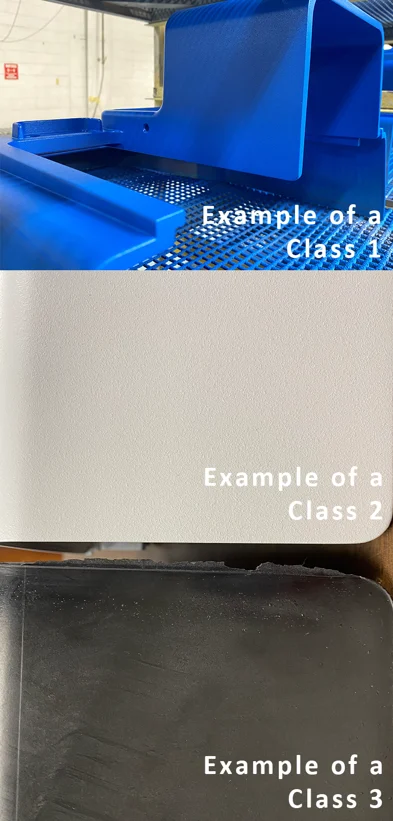
Most custom-molded products can have flow lines, texture, or blemishes that may require secondary operations, such as filling and sanding, to achieve the appropriate aesthetic requirements. As a result, the surface of a part is typically classified into one of three visual class finish categories: Class 1, Class 2, and Class 3. Each classification features different tolerances that determine the level of voids and blemishes acceptable on the part’s surface.
The categories are as follows:
1. Class 1 Finish – This is a high-quality finish, typically for customer-facing products, such as front panels or other visible surfaces. This class provides superior quality and uniformity in texture, color, and thickness. However, there may still be some minor voids and blemishes permitted but not visibly noticeable.
2. Class 2 Finish – This is a medium-quality finish, typically not for customer-facing products but still visible, like the sides or backside of a product. This class provides good quality and uniformity in texture, color, and thickness. Small or limited voids and blemishes may still be visibly noticeable.
3. Class 3 Finish – This is often an as-molded finish and the most economical for parts that will not be visible to the consumer. This class is typically ideal for interior surfaces or components that will never be seen. So, voids and blemishes may be readily visible.